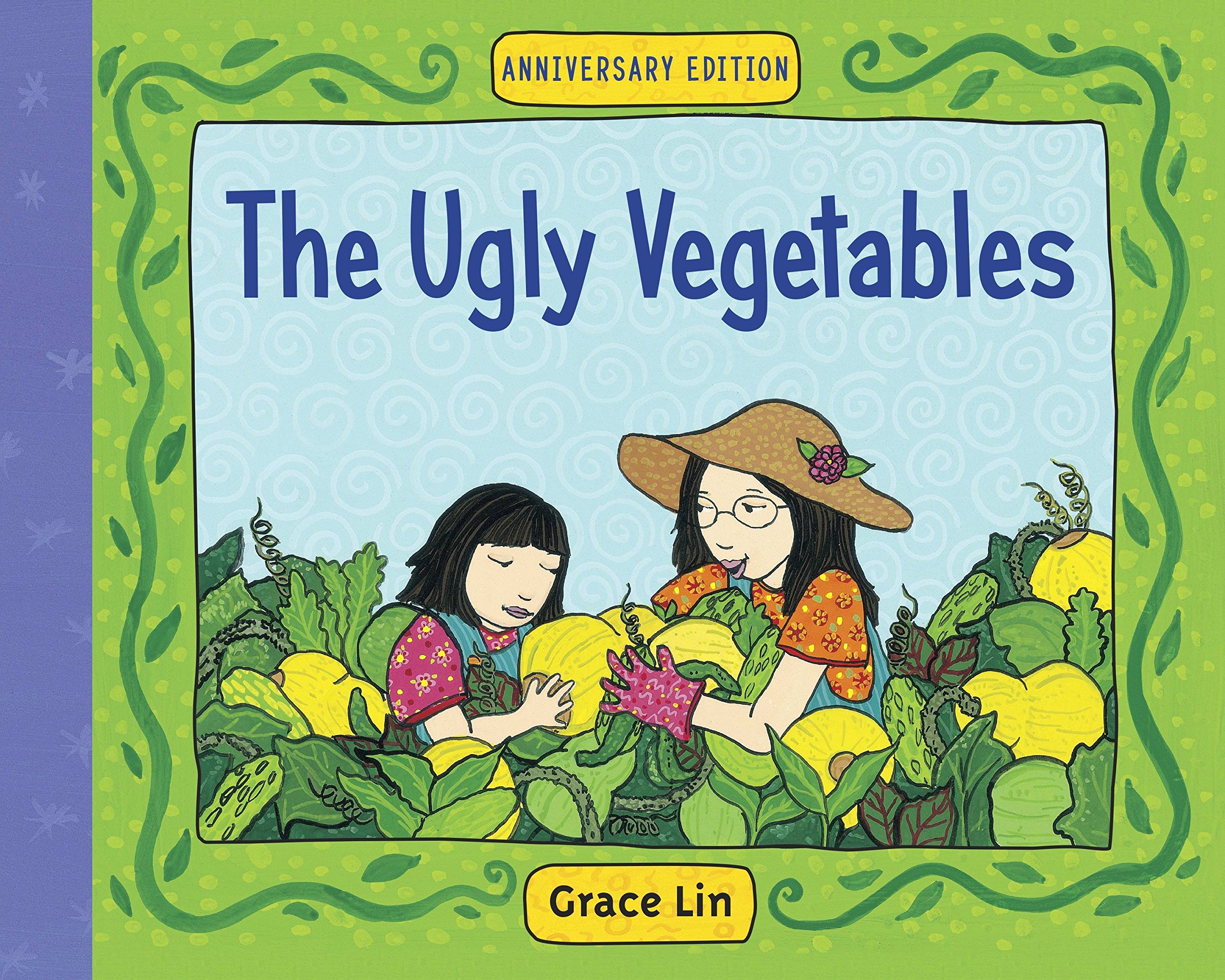
“The Ugly Vegetables” by Grace Lin is a title that focuses on the Chinese culture, but can be readily and easily expanded into a discussion of many other cultures. What I mean is that this text features the differences in the Chinese writing/language compared to English, for example, as well as introduces the idea that just because people and their cultures are different, we can share and work together. We all have something special and unique to offer and, if we collaborate and work together, great things can flourish (and in this book, things come to blossom quite literally).
Basically, this book is centered around a little girl who is planting a garden with her mother who is Chinese. From the young girl’s perspective, the flowers in the neighbors’ gardens seem much prettier and better than their plain, dark green vegetable garden. However, once the neighbors and the little girl and her family all come together to share the mother’s tasty Chinese vegetable soup, the young girl gains a great appreciation for the “ugly vegetables” from the garden she planted with her mother.
As you can see, so much can be gained and extracted from just this one book. First of all, we readers get to see how, as I mentioned, people may look differntly(speak differently, act differently, write differently, etc.) but we are all people and can come together and work as one or share with each other. In the book, the Chinese family shared their vegetables and the soup they made with their neighbors and the neighbors (from various different cultures) shared their beautiful flowers with the family. So, yet another thing we can take away from this book is how to work together and share effectively.
Not only does this book feature many Chinese vegetable names and how to pronounce them (with even a recipe for Chinese vegetable soup on the last page), but it incorporates the whole “you cannot judge a book by its cover” idea. Though this may seem cliche, I still think it is an important message for children to grasp, and can be taught from an early age. Sometimes our assumptions about books, movies, towns, etc. and even people are accurate, but, many times, they are simply just not true! They can also be hurtful and lead into stereotypes, judgement, and misconceptions.
Yet another powerful aspect of “The Ugly Vegetables” text is the fact that it can be used to describe how things grow. In Jumpstart, and as a Jumpstart team leader this year, my team and I are using this book to introduce our sixth unit (the “things that grow” unit). This book teaches about how vegetables, fruits, flowers, etc. need things like sunlight, food, water, etc. to grow and be healthy. So, this book offers a few different benefits and can be integrated into the classroom for a variety of different objectives and goals.
A branch out activity from this book could be having the class start their very own garden on school grounds or plant their own vegetables, flowers, or fruits in the classroom. This book, as you can see, is so rich in the fact that it is so diverse and opens the door to, truly, so many different activities and assignments. Personally, I know that when I was in kindergarten, my teacher would read books to start new units, and we even planted our own flowers on school grounds with parents and teachers. Even the principal got involved! It was a school-wide activity! I remember it even to this day!
Another reason why this book lends itself well to a unit on “things that grow,” gardening, etc. is because it elaborates and expands on the different tools needed when gardening. For example, it talks about wheelbarrows, hoses, and shovels and how they work to help vegetables, in this case, grow and flourish. So, in this way, there is so much vocabulary to gain from this short text, too, and it paves the way for such grand conversations!
Another aspect of the book that I must note, since I assume people who are reading this post right now are or want to be teachers, it is important that, if we read this aloud to children, that we know how to pronounce/read the names of the Chinese vegetables beforehand so we do not insult or make these new words seem “strange” or inferior to English. However, this is not such a challenge for readers since the names and their pronunciations in English are on the last page of the book. I just wanted to mention this because it is important that we teachers do our best to include all cultures, not alienate or belittle them.
Although we read this book by Grace Lin with children from 3-5 years old in preschool through Jumpstart, I think it is more appropriate for kindergarten and ages 5-6 and beyond. The vocabulary can be a lot and the words that stem off from this main, central vocabulary would, in my opinion, be better suited for the 5-6 age group. But, even though I am in college (and 20 years old), I gained a lot from this book which I think is saying a lot. It opened my eyes to different cultures and especially the Chinese culture and I got to explore how their writing/text differs from that of English works. In other words, I gained a great appreciation for the Chinese culture through this book. I really did!
In a nutshell, then, I think this book is a keeper. It is so enriching and the story is so creative but valuable all at the same time. I absolutely would recommend this book to teachers (especially those teaching in the younger grades). There is no way students would not be interested in this book either, as the colors are so bright and wonderful and the story is so genuine, sincere, and powerful. It would be hard to come up with a reason not to teach this book, and that, I think, says a great deal about the preciousness of this book.
 Emma's Education 307 Class