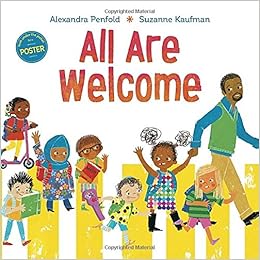
I found “All are Welcome”, by Alexandra Penfold and Suzanne Kaufman, to be a very welcoming (as the name would suggest) and inviting book. For this reason, then, I think this would be a stellar book to read on the first day of school in an elementary school classroom. Because of the vocabulary in the book like adversity, diversity, haste, etc., I would say that this book is mostly appropriate for second and third graders. However, it is valuable regardless, even if it was taught in a fifth grade classroom. The concepts that the book brings up like adversity and community really are strong, and the authors do a great job with the rhythm and rhyming in this book too.
For example, one page reads, “Pencils sharpened in their case. Bells are ringing, let’s make haste. School’s beginning, dreams to chase. All are welcome here.” Students will develop or nurture great phonemic awareness and can even try to finish the sentences that rhyme (a great challenge)! But, every page ends in “all are welcome here,” so students can always chime in at that part.
The book strays a little, though, from this “all are welcome here” pattern by the end of the book and instead says “you are welcome here.” I thought this was a nice twist and it really makes students feel valued, appreciated, and like they belong (because they do)! The illustrations also feature a wide variety of different students and teachers and I would find it somewhat surprising if a student could not recognize at least a little sliver/piece of himself/herself in the images, since they are so inclusive and diverse.
Another aspect of “All are Welcome” that I really love is the kindness this book emphasizes. It emphasizes kindness more on the side of implicit rather than explicit, which I think makes it all the more meaningful, effective, and powerful. In other words, instead of just saying “we need to share” or “we are kind” or “be kind to everyone,” this book actually SHOWS the kindness and the good nature of the students and teachers. Students can tend to put up a wall when they are being lectured at, but, instead, this book displays kindness rather strategically and thoughtfully. It shows characters sharing with others, welcoming others, and playing together and they are all smiling and happy. This makes students realize that if we include everyone (share, are kind, etc) that the outcomes will be positive.
I just have to mention, too, that the illustrations in the book “All are Welcome” are so detailed and wonderful that I think this book would also be great for a picture walk.
I also love how this book paints school in a positive light, as, unfortunately, I find that many characters in books these days do not want to go to school (for example, we have books like “No, I Won’t Go to School” and “I Don’t Want to Go to School”). Not that these books can never be read with children, but I appreciate the positivity in “All are Welcome.” In another way, although these characters in these books may then change their minds and learn that they actually love school, I think we need more books that are just purely positive and portray school in a good light. If students feel that others do not like school, they are more likely to be resistant to school (and education) too.
Yet another component of this text that I find valuable is the repetition. I touched on it briefly, before, but I want to expand in regards to theme. Students can make the connections/see that there are clear connections between the illustrations and the words as well as the connections from page to page. They go in order (the beginning of the book is at the start of the school day and the end is when the students go home and then go to school the next day or “start anew and fresh” the next morning). Because of this, then, we can discuss theme and other aspects of books with children. So, in this way, then, we can start incorporating even more important vocabulary (especially tier 2 words) that are essential for success later on.
The vocabulary in this book was priceless as well and really challenging, but appropriate for many children ages 7-9 as mentioned. I cannot believe how much of a “punch” such a book can pack! It explored not only diversity and inclusivity, but kindness, sharing, helping others, learning, new beginnings, etc. and, for all these reasons, I find this text irreplaceable. It truly is a fabulous work that I would definitely recommend to educators.
 Emma's Education 307 Class