I took away so much incredible information from the readings and videos in this module. And what I especially loved about this third module is that it connects to other courses and the world we live in today so well! In other words, I am saying that these resources in module three are very relevant, important, and applicable to today’s modern society and we can learn a lot from the module as far as teaching children goes too.
Taken together, these resources show that we, as teachers, must not be close-minded. As the piece by Jacob McWilliams’ displays, there are not just two different ways of thinking or being. For example, not everyone fits “neatly and perfectly” into the gender he/she was assigned at birth. Putting people in boxes rarely does anyone any favors. In fact, it usually causes serious problems such as isolation, humiliation, and/or racism. Another aspect of this article that really stands out to me are the sentences about social norms and social influence. As a Team Leader for the Jumpstart program at my school, I see just how social norms play a major role in who children become/their likes, dislikes, and attitudes about certain things. For instance, one day during center time, I showed a poster I had made with tons of eye-catching, sparkly glitter on it. Several students (two of them 3 year old boys) came up to see what the glitter was like up-close. They seemed very intrigued and they liked the gold glitter a lot (which is generally viewed as very girly and feminine). Being that they were only 3 years old, however, they were not conditioned to the social norms of society that say that boys do not like sparkles or glitter and girls do. In that same class, there are also a few 4 year old boys and even 5 year old boys, and they all did not seem impressed by the glitter. This just shows that, as we grow older, we are conditioned more and more to behave in certain ways. We are even made fun of or bullied if we stray from these norms too, and this is why, as teachers, we must teach compassion, kindness, tolerance, and respect for others’ preferences, and the first step to being these things is to recognize that these norms do in fact exist. In my opinion, and thinking more deeply than McWilliams’ piece, these norms rob us of our full potential. For example, some women would probably make fantastic surgeons, engineers, etc., but, because of society, will never become these things. Women are often confined to a set number of jobs (teachers, stay-at-home mothers, etc.) by society’s standards. When people deviate, they are sometimes doubted, bullied, or stared at in disbelief. At a conference for Jumpstart in November of 2018, a speaker named Jamal Jones made a presentation that has stuck with me so much to this day. He first started by showing everyone a scenario (titled “The Surgeon’s Dilemma”). It is below for your reference as well.
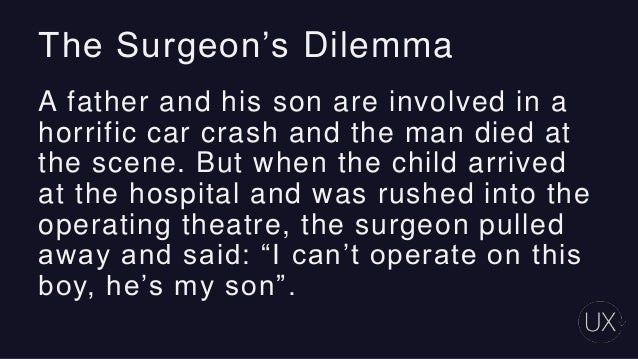
At the conference, everyone was told to read it closely and carefully, and then determine what was going on. Everyone in that room (and the room was jam-packed with at least 50 people) sat there stumped and confused. We all thought that the surgeon had somehow come back to life or was not really dead at the scene of the crash. We thought, “It must have been a mistake.” In fact, we came up with a bunch of crazy other scenarios besides the correct solution (which was that the mother of the boy was the surgeon and she said, “I can’t operate on this boy…”.
Clearly, this really opened my eyes to the fact that we, as human beings living in society, all have some level of bias (and unconscious bias) that we must work to erase or understand at the very least. Knowing we hold biases is the first step and once we realize we are biased, we can work to change. We cannot be in denial. We all have biases. The work from McWilliams’ really resonated with me and reminded me of this experience at the conference because, in both cases, we are talking about social norms/expectations and biases. I think it is essential that all people (and not just educators) understand this concept and grapple with it. It’s not enough just to be a “nice white teacher” (see https://www.ragazine.cc/2018/03/jessica-powell-and-meredith-sinclair-education/) because this perpetuates and worsens the damaging biases, stereotypes, etc. as I learned that semester through my classroom management course with one of the authors of this article, Dr. Jessica Powell.
Another article that really resonated with me is the article by Alfred Tatum about engaging African American males in particular in reading. It also connects to the school to prison pipeline in that teachers and administrators may not understand where their students are coming from and so they assume their behavior is ill-willed or see it as threatening. Then, they get the police involved and the school to prison pipeline perpetuates itself. An example of this is when African American males act tough or just simply interact with their peers. They may say things to appear tough (as society may have conditioned them to do) or tell what seem like cruel jokes to one another. What some teachers fail to understand, however, is the fact that this is how they “get along” or interact and it is not always necessarily bullying. In fact, it may just be jokes and play for them. It is important that we understand our students as teachers as well as the societies they live in. We must be cognizant of the cultures around us! If we know what’s relevant to our students, as the article touched on, then we can truly select literature/text that relates to our students. If we do not do this, it’s like trying to find a needle in a haystack or strike a specific chord out of a million musical instruments. Exactly. It’s nearly impossible. I firmly believe that teachers must be very aware of the problems, likes, dislikes, interests, social issues, responsibilities, etc. of their students. What a teacher sees in the classroom is just a very small and isolated section of a student’s life. It’s just a snippet; not the whole picture.
These are just a handful of the major takeaways I got from these articles of module three. They were super impactful and interesting and I am so grateful I was given this opportunity to read them! I feel I will be so much better of an educator now as a result of just a few somewhat short readings. It is truly amazing!
 Emma's Education 307 Class